Memento Mori
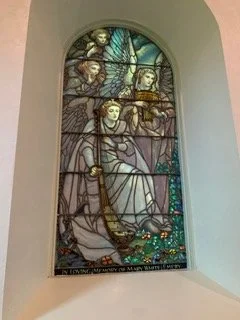
We gather in the Boston College Chapel, morning light brightening the cobalt blue and crimson stained glass, casting a glow that illuminates the peach-toned faces. Angels? Disciples? I squint, trying to discern the story each pane tells.
In the opening hymn, “For the Splendor of Creation,” the sound of the organ music lifts us. I try to find the right pitch, comforted that my voce can blend in on this June Wednesday, an annual gathering of Heads of School.
Last year, I sat at this service between Susanna and Penny, two friends I love, one of whom is now gone.
All the heads’ organizations to which I belong–and there are three–memorialize members who have died since the group’s last gathering. November, January and June. We sit quietly in pews, bearing witness. Landis reads a tribute for each of the eight colleagues who have died this year. Susanna is the only one I really knew, the one I grieve. Her face smiles up at me from a glossy page in the program, and my mind wanders to our long phone calls, to laughing at her wicked humor , to recalling her love of the state of Maine, her good advice about purging and moving, her penchant for Boden dresses and the color orange–what a Princeton tiger she was–and her gorgeous cashmere scarves. Our friendship was born over twenty years of leading girls’ schools together. She was only one year older than I. I often have the impulse to call her, can’t delete her number from my phone. Autumn holds my hand as Landis shares Susnnna’s biography, which feels insubstantial, wispy, compared to my vivid, multi-faceted friend.
We listen to Geoff read a poem, listen to the choir sing It’s a Wonderful World, hear words by JFK about moon exploration, and then are transported by Sarah, whose eloquence weaves all the strands of the service together, reminding us of what it means to live with loss, to reach, to strive, to be unwilling to postpone hard things, to fly as the yellow warbler does (in the poem by Jim Harrison) to Costa Rica without a map.
Living without a map makes me think about this past year–one in which I, too, sought to find my way and to absorb loss . The loss of Susanna, certainly, and also the loss of identity that retirement makes inevitable. Who am I when I am not a school leader? How do we make a life when we do not know where, exactly, we are going? Do we ever know? I think about how unfamiliar it has felt to be unloosed from school, far away from the sound of girls chattering in the hall, a year removed from assemblies and tedious complaints and grumpy folks. How I missed all of it. And yet, recently, I have felt lighter, felt as if a new chapter is taking shape. I feel less bewildered, less exiled, more like things may “come round right.”
I gaze again at the stained glass windows–all those tiny fragments arranged into pictures, intricate mosaics assembled from thousands of pieces, each chosen and placed by human hands.
Then, I’m down the rabbit hole, thinking of the Tiffany Women. Louis Comfort Tiffany employed many women who who painstakingly pieced together glass in brilliant colors to compose exquisite stained glass windows and lamps. Tiffany did not permit them to sign their work. Women like Clara Driscoll–with whom I confess I am slightly obsessed–made iconic stained glass pieces because that was the work they were paid to do, but their anonymity makes me mad. Their windows fill me with awe, with wonder and delight, and Tiffany took credit for their labors. Our schools, too, are filled with women who didn’t get credit–teachers and leaders whose names are lost to time. I can recite the names of the women who led Agnes Irwin, Chapin, Laurel, but I’m suddenly overwhelmed b the magnitude of the many teachers and heads of school who lived, breathed and inspired children (and colleagues) in our schools and who we do not remember. Some of them were, no doubt, eulogized at meetings like this one, but how can even an elegant obituary contain a life?.
Two weeks ago, I shared the idea of “cathedral thinking” with a leadership team of a school where I’m consulting. My friend, Deborah, had written about it in her blog, and I was captivated by the concept that hose artisans who built cathedrals knew their work would not be finished in their lifetimes. But they invested anyway, believing in an endeavor, in a future they could not see. And, at the very moment I remember this idea, Sarah mentions cathedral thinking in her brilliant remarks. My worlds collide.
Schools ask us to practice cathedral thinking, too. Children grow up and leave us, and we may never know the ways in which they fulfill their promise and better the world, yet we persist The waterwheel of schools compels us. We are governed by familiar rhythms, by the optimism of new beginnings. We are seduced by the satisfaction of solving a problem or managing a crisis or helping a colleague or a family through a rough patch or raising the money to build a new building that we never occupy.
The schools I’ve loved existed before I was born and will stretch into the future after my death. It’s likely I will never really understand–for good or bad–the impact I have made on the schools I’ve served. I imagine some day, someone will read a memorial about me in a chapel like this one. And who sitting quietly in a pew will know me the way I knew Susanna? After all, a college friend reminded me recently that we are now ⅔ of the way through our lives. True and sobering. What is it, precisely, that makes a life? It cannot only be our work. Questions circle, like that tiny warbler, on his way to Costa Rica.
The women who made the Tiffany windows, the men who built cathedrals–their faces and names are lost to us. But while they were alive, they lived and loved, liked broccoli or didn’t, had dreams, twisted their hair up in pins and clips, preferred one hue to another when they selected the glass to use in windows or lamps. They went to work. They laughed. They met up with old friends, raised children, fell in love or out of love. As they worked, did they consider their deaths, what they would leave behind? I don’t know. I suspect such musings are the stuff of privilege.