You Can’t Step in the Same River Twice
You Can’t Step in the Same River Twice
As a senior at The Agnes Irwin School, I took philosophy with Eleanor Cedarstrom, a brilliant Classicist. Reading Plato, thinking about important questions, being involved in substantive class discussions, writing essays—all those requirements made me feel erudite and very grown up. In the intervening decades, I have held this memory: smart girls gathered around a seminar table, in plaid kilts and yellow or navy shirts, or the occasional crew-neck cable knit sweater—it was the late 70’s after all—in the hands of a brilliant teacher. If I peeked under the table, I’d see our feet in Wallabees and Docksiders and loafers and saddle shoes—just geeky enough to be retro and, therefore, cool again in 1977. Our teacher treated us as respected equals, engaging us in serious conversations about weighty topics. She challenged us and cared about us. Our futures glimmered in front of us: college, romance, jobs or grad school, families. I am not sure I have ever been more confident than my 17-year-old self, busy thinking big thoughts, on the verge of her life.
In that class, I learned Heraclitis’ truth, “You can’t step in the same river twice,” words which, of late, have echoed in my brain. There’s no going back; you can’t go home again; the only thing certain is change. I am betwixt and between, thinking about past, present and future—verb tenses, stages of life. I’m dreaming of the schools I’ve loved, the chapters I’ve spent in the three historically all-girls’ schools that have been like the three acts of a typical modern American play: beginning, middle, end, and, perhaps, now, some sort of coda.
Two weeks ago, the Laurel School Gators won the Division IV Championship. My husband and I were glued to our I-pad watching the semi-finals and the finals, both won by a breath by my brilliant, bold, beautiful girls. In the attic of our new home in Eagles Mere, we cheered and clapped and growled at the refs and hugged each other at the team’s thrilling victory. I cried a little—the build up, the excitement, the long years of trying. We were so proud. Of course, they are not my girls anymore. They never were. The whole time I was a headmistress, I worked hard to avoid possessive pronouns: my school, my girls, my faculty and staff. The fact is that I was in service to a school I loved, but it was never mine; it never belonged to me.
Soon after the basketball team’s big win, I found myself back in Rosemont at the Agnes Irwin School, “my school, where I was a “lifer”—the term used for graduates who had started in Kindergarten and spent thirteen years in the school. Technically, I started halfway through Kindergarten when the lower school director, Miss Sharp, who could fly a plane and went to our church, told my mother after my interview, “Oh, Cooie, bring her back tomorrow. She’s ready.” Though my eczema meant I wore little white gloves and classmates didn’t want to hold my hand, I was ready. I read at the age of four. I needed to be in school. Agnes Irwin taught me to think, to write, to stand up for my beliefs, and to believe that my voice mattered. The subtext of my girls’ school education was that being smart, ambitious curious, empathetic, and tenacious mattered much more than looks. That didn’t help me so much at awkward dances in the Haverford School gymnasium when I hoped—fervently—that someone would ask me to dance, but, over time, I began to understand that men who cared about me did so not because my hair looked I had emerged from an Herbal Essence Shampoo ad, but because of who I was and what I thought and how I walked through my life..
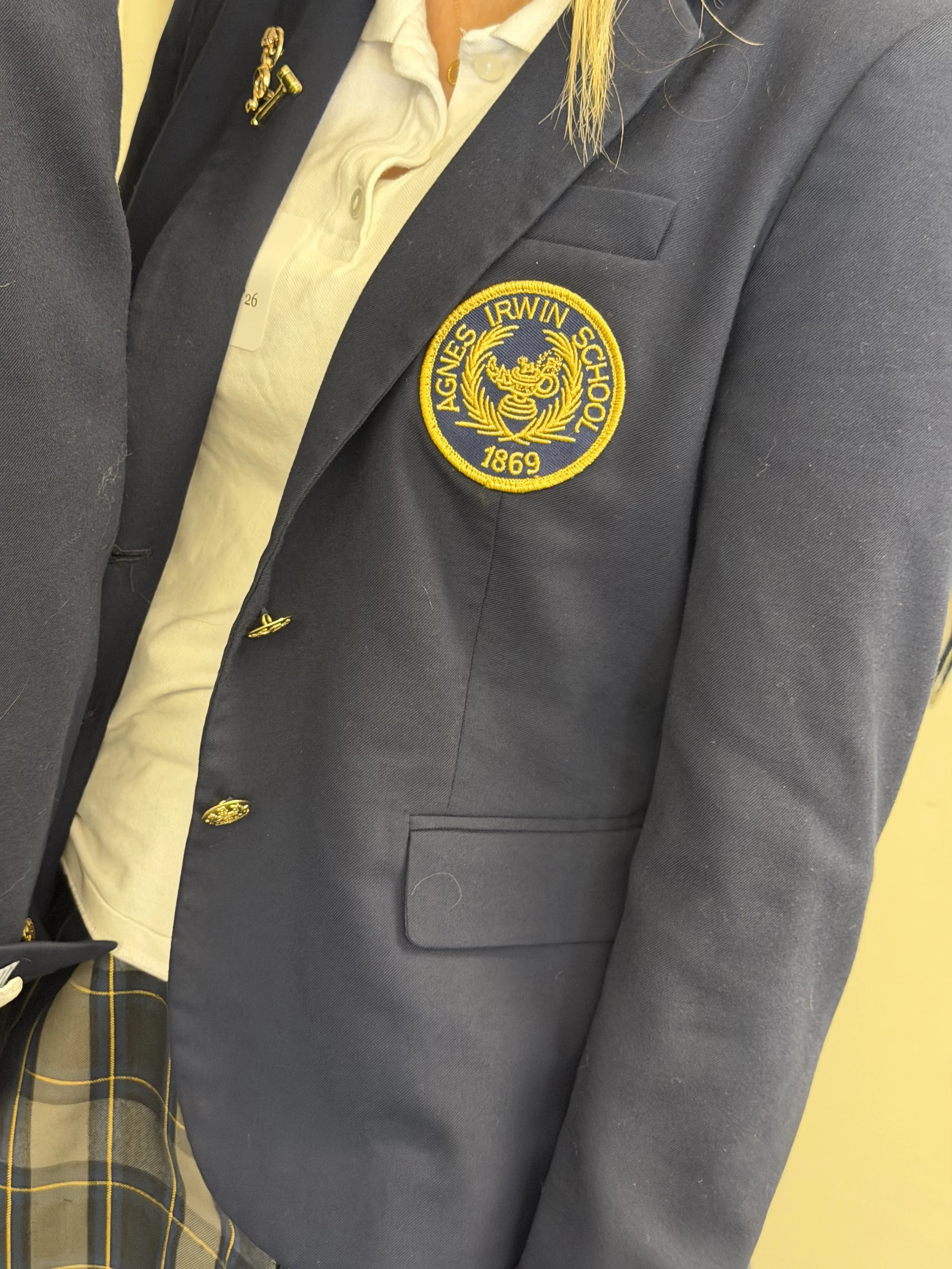
At Irwins for a board of trustee visiting day, I ate lunch with two poised and eloquent seniors, Chloe and Saira, who proudly sported their navy blazers. In my last year of leading Laurel, I re-introduced the blazer—navy in 2024, rather than hunter green, which had been the tradition. It was a bold and slightly uncharacteristic move on my part, quite distinct from my typical process of gathering school leaders together to deliberate, weighing the pros and cons of such a uniform change. The students asked and I said, “Find me a blazer under $125.” They did. I said yes without consulting anyone, remembering my own AIS blazer and the way I felt like Pallas Athena when I wore it. Sometimes, we all need a shield. But I regret my high-handedness and suspect it was partially motivated by the realization that I was leaving. Out with the old, in with the new is a part of change, but it’s hard to live with the knowledge of one’s imminent departure month after month.
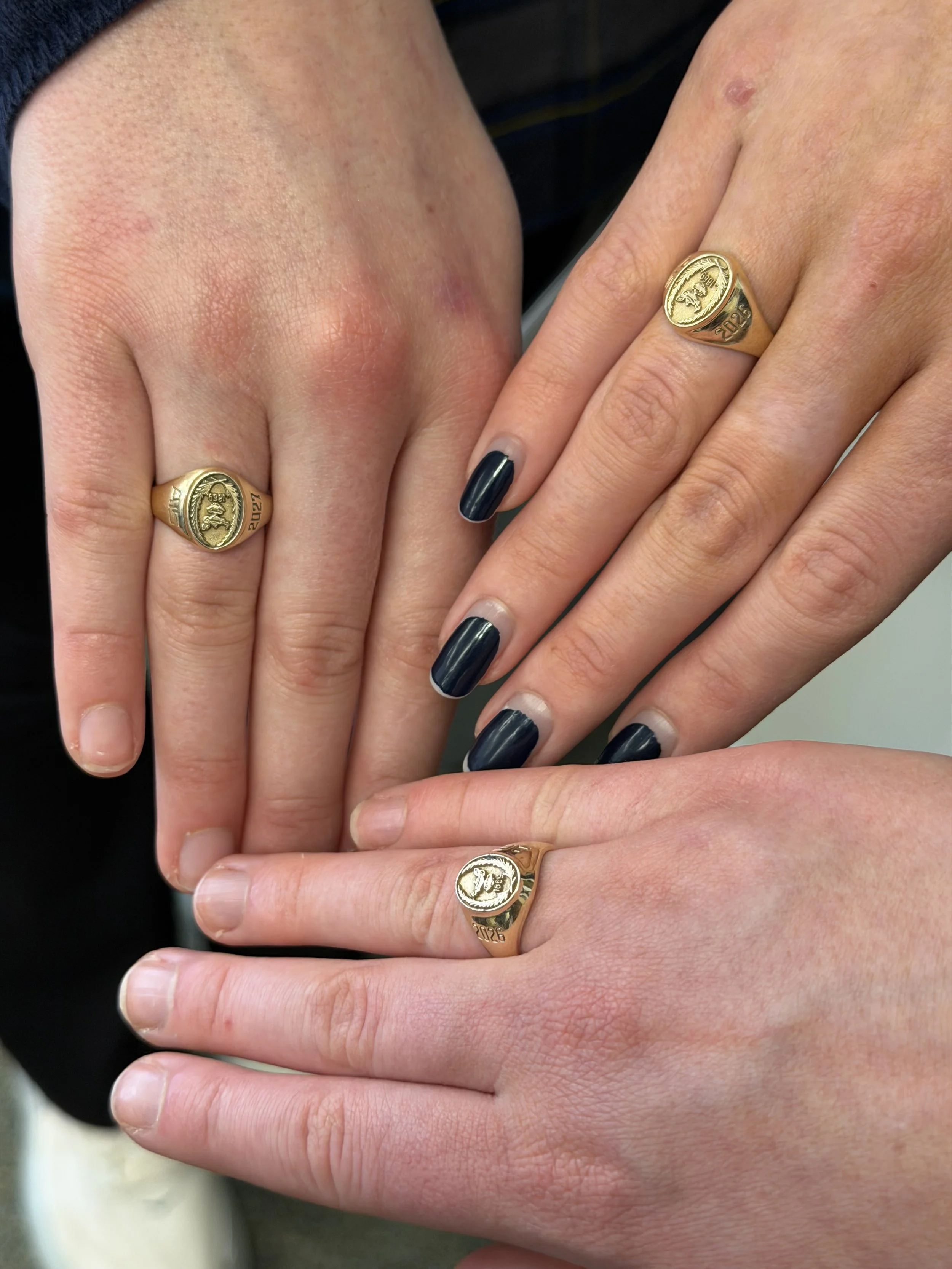
I had a wonderful day at Agnes Irwin and felt proud of the school and of the privilege of serving as a trustee. The buildings are beautiful with a much larger physical plant than “mine” of almost fifty years ago. It was familiar and unfamiliar at the same time, a landscape I often dream about, but with contemporary contours I do not recognize. My tour guides held out their hands to show off their school rings.
“Do you still get them in tenth grade?” I asked.
They nodded.
“Where’s yours?’ one asked. “Aren’t you an alum?”
“I am,” I nodded, sheepish. The fact is that I wear my Laurel ring, a gift from the Class of 2013. But, for a moment, I was sorry that I had forgotten to slide on my AIS ring for the visit.
Every time I turned into a corner, I expected to catch a glimpse of my teenage self or of my Lower School friends, but instead, what I realized was how much the AIS girls reminded me of the Laurel girls I miss every day. The speech patterns of the older girls; a group of Middle School students, heads bent together, constructing weight-bearing bridges with blocks and paper; the loud and proud 4th graders doing an alchemy experiment with pennies. I felt as if I knew all those girls; it felt like being home, home at Lyman Circle. Instead of green and white plaid, these Upper Schoolers wore navy and gray plaid skirts. This school has mostly modern architecture; Laurel’s turrets and nooks are like an Agnes Irwin Campus in Wynnewood before my time. And here, I was not the headmistress, just a curious stranger peering into her past.
“That’s where the ring my mom gave me when I turned sixteen rolled out of the spine of my Biology textbook,” I explained to my goddaughter, Grace, after I’d slipped away from the tour to hang out with her, feeling only a little guilty.
“Hmm,” she answered kindly. She’s a Senior now, also on the verge.
“Wait, where’s the door to the Middle School library?” I asked, feeling slight panic.
“It’s around the corner,” she reassured me, guiding me to the right.
What I remembered were glass doors that faced the hall, and a big, sunny space. This space was different, and the librarian, warm and gracious, was not Miss Barlow, a British evacuee child, who, with her three brothers, was raised on a farm in Muncy, a half-hour from Eagles Mere. It was Miss Barlow who gave me books that she thought were too “mature” for other girls. Miss Barlow introduced me to the Green Knowe Books and girls’ British boarding school stories. As fast as I read, she had more titles to feed me, knowing how ravenous I was for stories. Her English accent, her care, our mutual passion for books—she was an adult kindred spirit, and I loved her.
After my time at “my” school—it did feel as if belonged to me when I was a girl--I drove to NYC, where we have a small apartment that I keep forgetting belongs to us. I went to visit our daughters at the school where they both work, The Chapin School, which, for 20 years, was the place I worked, “my” school again. Much of the school’s layout was the same, but lots has changed during the two decades that I led Laurel. When I left Chapin, our girls were little; now, each has her own office! I ate dinner with colleagues from the 100 East End chapter of my life, and we reminisced, laughing, about field trips and friends and particular girls we loved and moments we had shared. Being with them felt like coming home. They don’t care a whit that I had been a head of school. I am one of them. The next day, waiting to have coffee with an old friend who started with me at Chapin but left several months later, I thought about life spooling backwards, an inversion of the future that girl in philosophy class contemplated. As I took the bus back to my apartment, I thought about the four decades since he and I first met: the husband and family I cherish, a long career as an educator, my writing life, and the wobbly-ness of this new, less familiar terrain that is “re-wirement.”. My self. No school belongs to me, and I do not belong to any school. No girls are mine these days—or ever were. There is no institution for me to claim. There are lots of new women I’m coming to know as a coach and as a tutor in a prison. Their stories call me. There are lots of chapters yet to write.
And yet, in the same way my adolescent self lurks—a benevolent spirit, perhaps—in the corridors and corners of AIS, so the young woman I was at Chapin and the seasoned headmistress I became at Laurel are all still in me. I am not school girl any more, or an English teacher, or the head of the drama department, or the Artistic Director of a magical summer program my husband and I directed for almost 30 years, or the mother of young children, or a Headmistress, yet all those selves are with me still.
You cannot step in the same river twice. You can’t go home again. You can’t re-visit the past. Except when I do in dreams or memory or in story.