Four Weeks of Josie Rose
Josie Rose arrives on the first of October, a new life at the beginning of the month. It is still warm the week she is born; summer lingers. Now, four weeks later, there are more leaves falling. The garden outside our apartment surges—a blaze of joyful color before the freeze that will come soon. I admire the pink roses, bright impatiens, coleus stretching up as I leave our little walk and take the subway uptown in my new role as grandmother. I thought I would be Marmee to my Josephine, but my chosen grandma name has already devolved to Marmalade. Secretly, it pleases me, reminds me of Paddington Bear. This is a new chapter—for all of us—and I am glad to be loosed from school, free to hang in NYC with my granddaughter and her moms and her aunt. I miss my husband, who is mostly in Pennsylvania with our pets, but we are okay, he reminds me. We have lived apart before. This is where I need to be right now. Present. Witnessing a beginning.
When she is born and my daughter calls to tell me her name, I love it. But it is my older sister who points out that the baby’s initials, J.R., match my brother’s initials—James Rhoderick. I cannot believe I missed it. My brother’s death, when I was fourteen, rose up as we tried to have a baby—loss upon loss—and when this daughter, our first—was born, I felt too anxious to attach any part of that huge loss to her name, but she is braver than I—what a gift she has given me. Of course she never knew her uncle, but she knows his presence in my life.
These first four weeks drift by, a cocoon of new. Tiny socks, tiny diapers, the scent of a tiny scalp. At home, all that has been prepared is now in use—the nursery light, the fancy recliner, the soft, soft blankets that spill everywhere. M’s wife, S., takes charge of laundry and sterilizing the bottles and pacifiers and all the pump parts. She files the papers she needs to adopt her own daughter. M. takes charge of keeping their daughter alive. I remember the feel of my own cracked, bleeding nipples, my sister’s encouragement, the confidence I gained, child by child, but nursing isn’t easy. Everyone has an opinion; everyone wants to tell you what to do and how to do it—and I remember that overload of advice before the internet was even a thing. M. looks to her phone for wisdom, for ideas, for comfort. I want her to trust her instincts, but that’s a process. There are tears and frustration and worry—both mothers and baby—and days when the baby latches and days when they both struggle, tears and howls.
“Breathe,” I remind her, trying not to hover, knowing that she can do this mothering-thing but remembering that learning to be a mom is not intuitive and that we are so hard on ourselves as we evolve.
M’s sister, our second daughter, whose Master’s thesis examined the transformation a woman’s self undergoes when she becomes a mother, is rich in empathy and love and humor. She handles Josie like a pro, having cared for her share of newborns during her own nanny years. Her arrival, to take a night shift, to check in, to be with us, lifts our spirits. She is not afraid of tears or hormones, and her calm helps her big sister to find calm.
M is hungry when she remembers to eat. She does not look like she was pregnant—ever. Is she too slender, I worry to my husband, privately by phone.
“Feed her,” he suggests.
Casseroles of lasagna and chicken parmesan, pots of chicken and dumplings, trays of enchiladas, batches of pecan squares are delivered by our son-in-law, delivered by M.’s best friend. There are loaves of pumpkin bread and bagels brought by S’s family.
I put tiny plates of pecans and blueberries, cucumber rounds and apple slices, cheese and crackers by my daughter on the couch, offer lemonade and cider, coo encouragingly. I bring coconut water and run to the store, make soup, make her bed, tidy the kitchen and the nursery, walk the dog occasionally. I am watching her become the new version of herself, watching her handle her baby with more confidence each day.
Hormones and swollen breasts and the adjustment to being someone you were not a few days or weeks ago and bleeding that you think should end are part of the physical transformation to motherhood. There’s a reason butterflies take time to develop within a cocoon—the process of transformation is more violent than gentle.
I think about Josie, too, emerging. How bewildering it must feel to be born. She prefers to be swaddled tight, legs drawn up close, frog-like, cuddled to her mother’s chest. But she’s determined to get her arm up and free from the swaddle—she’s an escape artist. We adultopomorphize her immediately, ascribing the qualities we imagine we see in her behaviors to her temperament or personality. She’s a fighter, determined, brilliant. So many words for such a small person. I note, furiously, how gendered words fall from my lips: “pretty, princess, darling…” and self-correct, raging at a culture that has done its work on me so well.
The days slide by. Nurse, poop, change, nap, repeat. This is the work—not email, not writing—just grand-mothering, being on hand if I am of use.
“She doesn’t do much, does she?” our son remarks, meeting his niece. He will be her sports coach, her fashion advisor, one of her cool uncles.
“Well, she’s a newborn,” I say, secretly proud of her many accomplishments: nursing, pooping, sleeping, making tetradactyl sounds, opening her eyes and looking at the light.
Carrying Josie into change yet another diaper, I overhear my oldest say, “My mom says I’m the mom, and every time she says it, I try to believe it more.” My eyes fill.
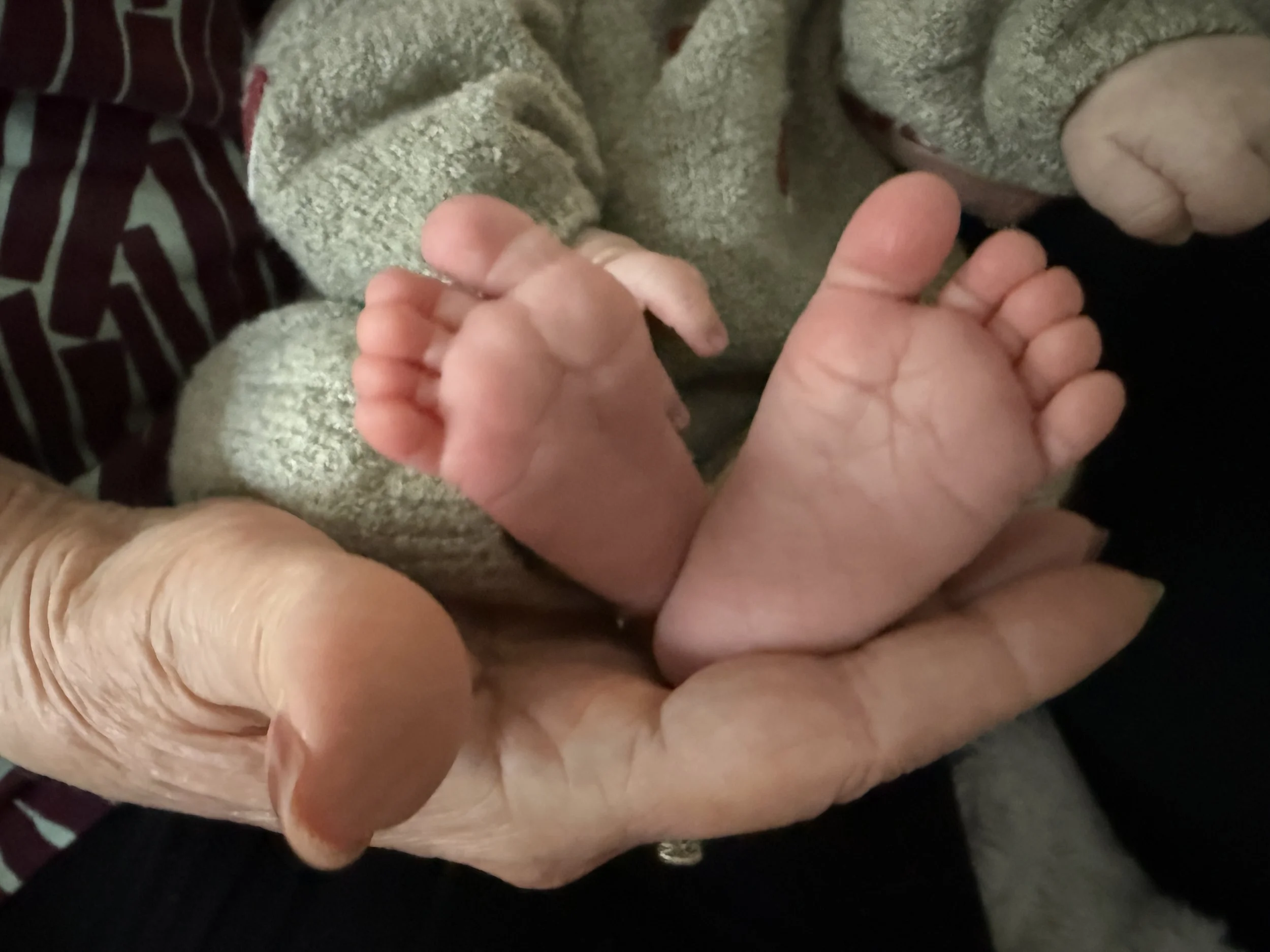
We wash our hands a million times eaxh day, struggle with the sticky tabs of tiny newborn diapers, try out different swaddling techniques. My husband brings the mobile that hung over our children’s cribs—black and white plush cows, none the worse for wear after 33 years. Josie lies in her bassinette transfixed, staring at them adoringly, Holding her, I marvel at her intricate ears, the tremble of her lower lip, her infinitesimal eyebrows—lighter than our daughter’s eyebrows--her toes that curl over my finger, clutching. She has a strong neck, lifting it and hurling it. She balls her starfish hands into fists, furious, gripping a clump of her mother’s hair. She grows, tipping the scales at more than 8 pounds. We feel triumphant; she left the hospital at 6 lbs, 3 ounces. All the hard work of nursing pays off. The lactation consultant tells our daughter she makes enough milk to feed the entire Upper West Side. I remember my own pathetic attempts to pump, how labor-intensive it was and unfruitful. I feel somehow proud of my daughter’s remarkable supply. A freezer arrives just for breast milk.
The dog, Zoey, a miniature dachshund, who may be a trifle over-indulged, eats a cider donut while we are at the pediatrician. We come home to discover the plastic container on the floor, with half a donut still inside--there had been two earlier in the day, but they were not large donuts as donuts go. M sees nutmeg listed in the ingredients—and nutmeg is allegedly deadly for dogs. I suggest the dog seemed fine, but the new mother, always anxious about health issues, hands Josie to me and zooms off to the emergency vet--Josie opens her eyes—bigger each day and so blue--untroubled by the excitement gazes. We have a fine time. I dredge up all the baby songs stored in my muscle memory, but unsung since our son’s babyhood. After several hundred dollars, the vet confirms that the dog is just fine...the dog, however, is un-thrilled by the arrival of this small being who seems to have taken up permanent residence. I think the donut eating was an act of revenge.
The things that have been important in my daughter’s life shift with the baby’s arrival. I can see her, pulled to her school community; she misses the chatter and the sense of purpose she derives from being a competent school leader, but her colleagues phone and facetime, and those connections buoy her. Being Josie’s mom is brand new, but writing curriculum is familiar—both things can be true. I remember feeling startled that everything at my school—her school now--could go on without me when I had this daughter I felt as if I were missing out, but I see my own daughter managing. She knows her job right now is her baby girl.
Gifts arrive. I fold new blankets, put the onesies my school head pals send by the washing machine. I begin to take some Zoom calls, work on a few presentations when Josie and my daughter take a nap. Gradually, I feel the other bits of my own self pulling at me. But most obligations wait. Josie will only be newly born for a few more weeks. This Marmalade feels lucky to be of use.